Posts tagged altLab
Workshops at BetaLab
2In the next weeks we’ll be giving two workshops at BetaLab, a co-working space organized by betahaus| within the Chiado-After-Work program.
Here’s all the information and workshops’ schedule (in Portuguese):
Workshop DIY Kinetic SolarBots — Construa o seu próprio robot cinético solar.
Neste workshop os participantes vão construir um pequeno robot cinético através da montagem de um circuito solar com um pequeno motor e do design/modelagem do corpo do robot com Shmelzolan (plástico utilizado em artesanato).
Datas : 12 de Maio / 19 de Maio / 26 de Maio
Horário : 17h — 21h
Preço : 25 Euros/Pessoa
Local : Rua Garrett, 70 (Baixa, Lisboa)
CC : Video by xdatelier (http://xdatelier.org/)
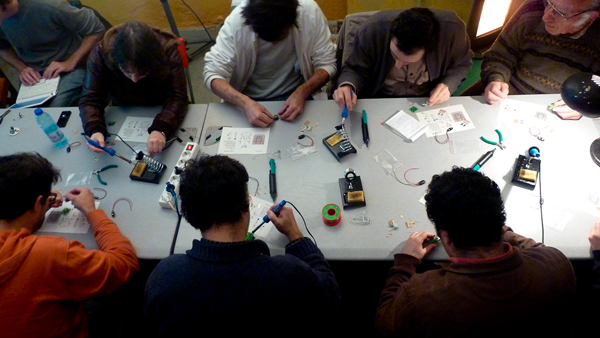
Workshop Electrónica Aprender a soldar
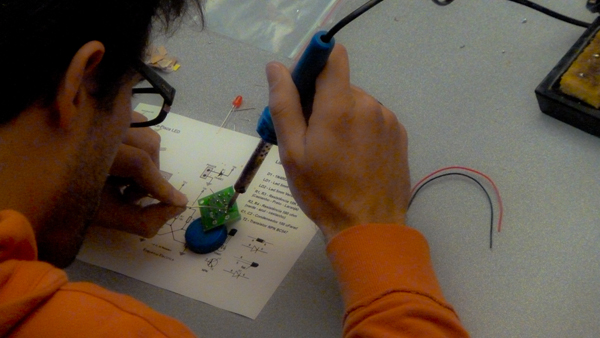
Qualquer pessoa é capaz de fazer uma boa soldadura, é só uma questão de prática! Neste workshop aprendemos a soldar construindo circuitos muito divertidos como o Pisca-Pisca LED, uPONG (Retro Video GAME), Drawdio (um lápis/pincel que emite sons enquanto desenhámos) entre outros.
Datas : 14 de Maio / 21 de Maio / 28 de Maio
Horário : 17h — 21h
Preço : entre 10 — 35 Euros/Pessoa (consoante o kit seleccionado para construir)
Local : Rua Garrett, 70 (Baixa, Lisboa)
A inscrição para qualquer um dos workshops numa das das disponíveis deve ser efectuada via email para o endereço : daniela@betahaus.de
Mini-workshop “Motores de Passo”
0(scroll down for English)
Vamos pegar aleatóriamente num motor de passo e tentar descobrir que tipo de motor é, desenhar um diagrama simples do mesmo.
Depois vamos pegar no ferro de soldar (não há que ter meeeeeedo :)) e montar um circuito que permite controlar esse motor a partir de um Arduino ou qualquer outra placa baseada num microcontrolador.
Todo o material é fornecido e fica para os participantes, sendo apenas necessário trazer ferro de soldar e multimetro (ou esperar que alguma alma caridosa vos empreste).
O número de participantes é limitado pelo que, se disserem que vêm, contamos MEEESMO convosco ;)
Para inscrições e pedidos de informação: workshops /arroba/ audienciazero.org
Lotação máxima de 10 participantes
Sábado 13 de Março de 2010
AltLab em Cacilhas
14h00m
5€
Let’s each of us pick up a random stepper and try to find out what kind of stepper it is, draw a simple diagram.
Then pick up the soldering iron (have noooooo fear :)) and assemble a circuit to control that motor from an Arduino or any other microcontroller-based board.
All materials are supplied to the participants and everyone gets to keep them; you’re just required to bring your own soldering iron and multimeter (or wait a random amount of time to borrow someone else’s).
The number of participations is limited, therefore, if you tell us you’ll come, we’ll REEEALLY be waiting for you ;)
For registration and information requests: workshops /at/ audienciazero.org
Maximum of 10 participants
Saturday, March 13 2010
AltLab @ Cacilhas
14h00m
5€
First Soft Circuits Open Lab
0
This Sunday we’re holding our first Soft Circuits Open Lab at the School of Fine Arts in Lisbon (FBAUL — Faculdade de Belas Artes de Lisboa). There is no predefined structure for the event. We will meet for the course of one day with the purposes of sharing knowledge, experimenting freely, advancing on-going projects, and just having fun working together. Some of the people attending will be specialists in electronics and others in textiles. Barcamp style impromptu presentations are very welcome.
Altlab will provide some basic tools such as pliers, scissors, soldering irons, ironing board, etc. But participants must bring all the materials and additional equipment necessary for their own projects/experiments (including laptops). Here are some suggestions: any kind of fabric, needles and thread, yarn, t-shirts, conductive and/or resistive fabric, conductive thread, conductive and/or resistive yarn, knitting and/or crochet needles, LEDs, coin cell batteries, battery holders, EL wire, strands of fiber optics, copper foil, copper adhesive track, aluminum foil, resistive foam, regular foam, arduinos (lilypad or any other kind). If you’ve never worked with any of these materials and don’t have them handy, come anyway, you can help someone else with their project and learn along the way.
For more information on soft circuits techniques and materials, check out the Soft Circuits Resources section on the openMaterials wiki.
This open lab will take place on February 21st, from 10:30 to 18:30, at the School of Fine Arts in Lisbon, room 307, 1st floor (since our own space is still under construction). All are welcome, there is no fee nor registration, but please do let me know if you are planning on coming: catarinamota(at)audienciazero.org
PAPERduino’s design
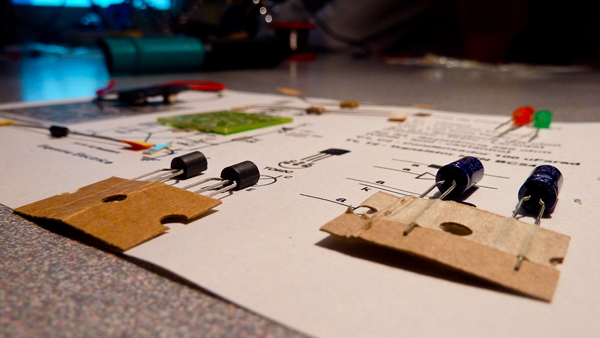
5This is a fully functional version of the Arduino. We eliminated the PCB and use paper and cardboard as support and the result is.. the PAPERduino :D
This is the the first version of the layout design, next we will try more designs, and other materials. You just need to print the top and the bottom layouts, and glue them to any kind of support you want. We hope that you start making your own boards. If you do, please share your photos with us, we would love to see them ;)
There is no USB direct connection, so to program the paperduino you will need some kind of FTDI cable or adapter. One of this products will be fine:
FTDI cable from Adafruit Industries
FTDI adapter from Sparkfun

Components list:
1 x 7805 Voltage regulator
2 x LEDs (different colors)
2 x 560 Ohm resistors (between 220oHm and 1K)
1 x 10k Ohm resistor
2 x 100 uF capacitors
1x 16 MHz clock crystal
2 x 22 pF capacitors
1 x 0.01 uF capacitor
1 x button
1 x Atmel ATMega168
1 x socket 28 pin
Female and Male headers
Instructions:
Use a needle to puncture the holes for your components.

Don’t rush, place one component after another and do all the solder work carefully.

Follow the connection lines.

And this should be the final look of your paperduino connections.

more photos of yesterday evening
0We had a great time building this electronic/paper pieces, and more are to come pretty soon .)


AltLab opening with paper arduinos
1We are happy to introduce the paperduino :D

This Tuesday AltLab had its first public session and we did a mini workshop on “paperduinos”, a new generation of cardboard arduinos. We had lots of fun and have many more ideas we’d like to try: different layouts, colored papers, and other materials. More info soon.