> Inscrições abertas!
Posted by Filipe Cruz
Yes, It’s that time of the year again. The days are longer. The school year is ending. The metropolis gets deserted. A never ending stream of music festivals get constantly promoted.
And while drinking a cold cola with a twist of lemon and 3 icecubes at that bar near your local beach; While overpowered by the multitude of colors from all the latest bikini fashion statements; All the nerds of this glorious land, pushed out to the ocean at the western point of europe, all of them nerds, can think only and only think of one thing: shouldn’t the dates of this years Sapo Codebits be announced by now?

Yes, forget about the school year that just ended, forget the latest code revisions from all those Google Summer of Code projects you been following for a couple of weeks, forget about your pseudo-holiday plans for a few minutes. Nerds of Portugal, recall what’s really important if not for just a couple of minutes: The dates of the new Sapo Codebits have been announced, 15–17 November, the organizers are already pushing out teaser pictures of the new space layout for this year. And it’s gonna be awesome again!
No, they’re not paying us to write this. We decided, out of our own volition, after reading one of their latest blog posts, that it was time to remind you all that there is an incoming battle looming above you. Yes, you, dear nerd who are thinking of attending Codebits this year.
“And why is that?” i hear you ask. Couz we pwned you hard last year with our Nuclear Taco Sensor Helmet Gameshow project. That’s why! Our pwnage didn’t happen out of the blue you know? We carefully planned this world domination and had to carry it through nice and steady to make sure we indeed had something grand we could put together in 48 hours and take the competition by storm. And unless you’d rather sit at home and cry yourself to sleep for another year you should be getting off your ass, right about yesterday, and also getting ready for this years event!
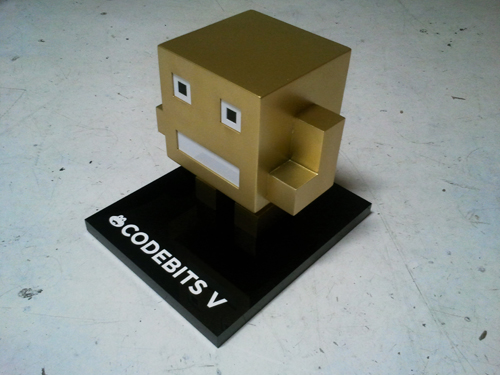
We know, we know, our unsurmountable talent is quite hard to beat. But even if you’re too scared of getting your ass served again, you should be using this time to come up with cool projects you could develop.
Common mistakes you should be avoiding:
a) doing yet another clone of something (without a subversive twist). Simpsons did it, if you can’t improve on an old idea you shouldn’t be touching it.
b) doing an hello world of a random new technology. Unless it’s taking full advantage of the tech on a useful way, it’s dead fish in the water.
c) trying to be funny without the tech to back it up. You’ll get entertainment votes but unless it’s something over the top it’ll be just sad.
And in case you haven’t noticed just having a good project idea isn’t enough, you need to finish it and present it in an engaging way. Our public award winner entry is a good example on how a wtf presentation trumps over project specs. People are more engaged when you _show_ them things instead of _describing_ them.
I’m not saying you should turn your presentations into a circus, it worked well for us last year because no one was expecting something so over the top. What you should aim for is to have a good useful idea and prepare an engaging demonstration. Show awesomeness first, explain implementation details later. And don’t forget that during those 48 hours that you are supposed to put your project together you will be getting distracted by 4 tracks of tech talks which you may or may not choose to attend. And i also heard eating and sleeping are important. So don’t aim for something unattainable, or if you must, at least master your weapon of choice before the event, to make sure the actual 48h development period goes smoother. Surrounding yourself with folks who complement your skills nicely is also a key factor, don’t neglect it.
Ofcourse all of the above is useless if you don’t get yourself selected to attend the event. Codebits is limited to 600 attendees and if you want to be one of them you need to start building up your karma by participating actively in the codebits website and forwarding the information to your blog, twitter and facebook contacts. A sure way to get admitted is to give a talk at the event, there will be a call opening soon to submit your talks. So if there is a technology you have been busy mastering for the last few months you might want to consider submitting a talk about it when the call opens.
And why should you care about attending codebits at all? Well, even if your project fails to win anything you’ll still:
a) get some practice with the technology you chose to explore
b) learn a lot from the talks presented you bothered attending or checked the videos after
c) check what everyone else is up to
d) have some unrestrained chats with other random nerds on the food queue
e) face the possibility of a near death experience by nuclear taco
f) have fun geek’ing out
g) get an awesome t‑shirt!
I have attended the last 3 editions of Codebits and i can tell you i learned new things in all of them. There is always something new out there worth checking out or new people to meet. I had a blast with friends, watched some nice gigs, shared my knowledge with fellow geeks and even managed to win some poofs and badges!
Every year we setup a small corner for the Audiência Zero labs, there we gather the folks from our 3 media hacklabs, LCD from Porto/Guimarães, altLab from Lisbon and xDA from Coimbra. We showcase 3d printing, give some electronic workshops and help each other out with random projects. Meet us there!
Why we need Open, Hackable Materials now – An Interview with Catarina Mota @ Meedabyte.
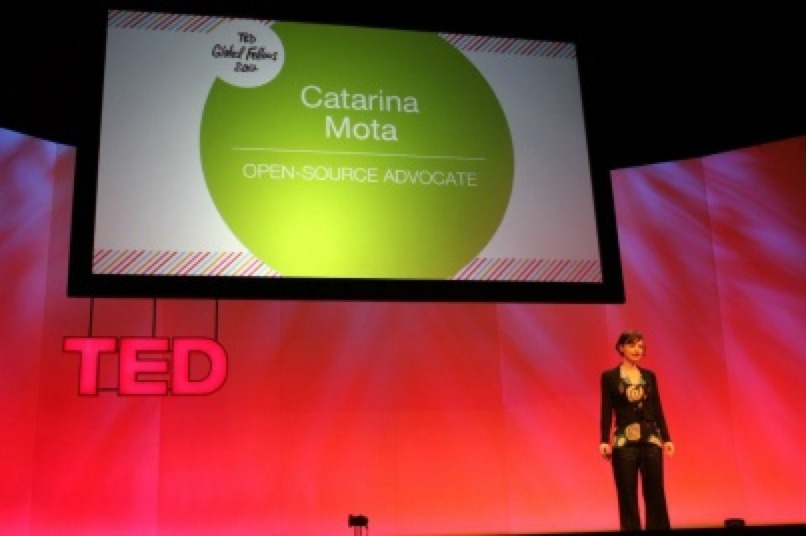
I had the opportunity to get in touch with Catarina Mota recently, while I was helping my friends at openpPicus, to connect with the Open Source Hardware Association. She is, no doubt, amongst the most eminent representatives of the Hackingmovement. To me, it’s extremely impressive though how one of the leaders of this revolution is coming right from outside the technological world and actually has a communication sciences and film college background. When I asked her to tell me a brief recap of her experience of hacking, she gave a really insightful and detailed story.

Catarina Mota has many friends. One of her friend’s fathers, when her friend was a kid, built a vehicle out of a bicycle and washing machine, because the family couldn’t afford a car. Culturally, we used to know how to make and fix everything. As the 20th century progressed, we lost that ability, but thanks to the maker community, we are slowly getting it back. By fostering the development and invention of new smart materials, Catarina hopes to help makers reach the next level.
What are smart materials? Fundamentally, they’re materials we are already incredibly familiar with like paint, paper and plastic. The trick is, all of these materials now come with a twist. Paint and ink, for example, can now conduct electricity such that people are able to paint circuits with a brush or, with the addition of a magnet, make a speaker out of a sheet of paper. Acrylic, a type of plastic, can now be infused with light diffusing particles so light can reflect through its entire surface instead of just the edges. What this means practically is, by flipping a light switch, you can turn your windows from see-through to opaque. Thermochromic pigments can be added to plastics so you can see when your baby’s bottle is hot. Possibilities are becoming endless.
However, in order to harness the full potential of these materials, Catarina believes that we need to have a deeper understanding of the components that are making up our world. We need to have a deeper understanding because when we do, we are able to shape the objects we use instead of those objects shaping use. Beyond being savvy consumers, by delving into tinkering, we open the doors to innovation. From mountain bikes to airplanes, semi-conductors to computers, history has repeatedly shown that it’s been the amateurs who have been the significant inventors and improvers of the world.
To bolster the tinkerers’ ability to create, Catarina co-founded openmaterials.org, a website where people publish information and aggregate research, papers, and tutorials by other makers. Her overall message is simple: draw from the experiments of the crowd and understand smart materials. Like learning about computers in the 1970s, the best way to ensure we have a say in our future is to acquire pre-emptive knowledge of emerging technologies now.

Photos by James Duncan Davidson
VIA [TED Blog]
Oficinas do Convento | uma co-produção com a Câmara Municipal de Montemor-o-Novo
A IV edição do festival Cidade Pre0cupada resolveu espreitar além-fronteiras e trazer até Montemor-o-Novo o Chile, a Holanda, a Espanha, a China, Cabo Verde e Japão. Música, Cinema, Conferências, Workshops, Residências Artísticas, Exposições, Instalações e Animação voltam a reclamar a cidade, invadindo conventos, festas populares, jardins e terreiros, mercados e sociedades. Esperamos por vocês na cidade criativa.
Artistas
André Sier (PT), Clara Brito (PT), Carlos Maza (CL), Dead J (CH), Dora S (CH), DJ Marcelle (HL), Gecko Turner (ES), João Bastos (PT), Ka Keong (CH), Lula’s Cachupa Psicadélica (CV), Magau (PT), Manuel Silva (PT), Nuno Lemos (PT), Onishi Yasuaki (JP), Peng Yun (CH), Rancho Folclórico e Etnográfico Montemorense (PT), Tiago Fróis (PT), Tiago Pereira (PT)
Parceiros
A Música Portuguesa a Gostar Dela Própria, Alt_Lab, Associação Cultural +853, Associação Espaço do Tempo, Câmara Municipal de Montemor-o-Novo, Casa João Cidade, Casa de Harina, Centro de Ciência Viva de Estremoz, Cooperativa Cultural PIA, CUT – Associação Cultural, Filmes da Praça, IndieLisboa, Junta de Freguesia de N.ª S.ª da Vila, Lines_Lab, Rede de Cidadania de Montemor-o-Novo
http://cidadepreocupada.oficinasdoconvento.com/