mm

mm

(2 comments, 33 posts)

Mauricio Martins. DVPT.COM owner, on-line company providing video production services.
Has a background in electronics and video production.
As a tinkerer develops projects in the area of physical computing, tangible and interactive interfaces.
Recently has participated as a collaborator in the Interactivos?10 at Medialab Prado and works with Near Interaction, a Portuguese company specialized in the development of creative interactive solutions.

Home page: http://ledsandchips.com

Posts by mm

RepRap Gen7 PCB… check!

2

Posted by  via T(h)inker it!

 
Today went back to AltLab for a little learning experience. A great friend of mine, Fernando Afonso, came to Lisbon to the launch of MEO Kanal, a product he helped bringing to life. Since he was here, he was invited by AltLab to give a small workshop on “PCB Making… The Fernando Afonso way”. :)The method used was Toner Transfer, where you print the circuit layout with a laser printer on cheap magazine paper (the more glossier is better), then, with the toner side over the copper side and woot… the “sandwich” off it go into a slightly modified laminator (around 10 times) and the it’s submerged in freezing cold water.The low quality magazine paper it’s easily scrubbed off the pcb and it’s ready to the acid bath.
We used Acid Cupric Chloride as etchant, when the pcb is submerged  it turns into a… kryptonite green… spooky I say!

In the end we’ve got a Generation 7 Electronics pcb for the Prusa Air… next step, buy the components and soldering it :D

AZ Labs showcase @ Vila Verde

0

Text by Filipe Cruz

On the 25 and 26 January, AZ Labs showcased some projects at the library of Vila Verde. This showcase was the first step in a series of iniatives promoted by Casa do Conhecimento in Vila Verde in colaboration with Audiência Zero. 500 students from local schools were brought to a secret room in the municipal library to discover creative, artistic and open source applications of technology we had setup to show them.

The response from the students, teachers and organizing comittee was great and we look forward to colaborate some more with the people of Vila Verde in the near future!

In total we showcased 7 projects.

Drawdio – An esoteric electronic instrument invented by some folks at MIT exploring the conductivity of graffite on paper or just common water. The user closes the electronic circuit through touch, triggering sound through a small speaker. Showcased by Ricardo Lobo and João Gonçalves.

GroundSpines Graffiti – The laser tagging prototype developed at xDA, inspired by theGRL laser tag system. This project was originally developed by Tiago Serra, Tony Gonçalves and Victor Martins to beautify abandoned buildings in Coimbra. Showcased by Pedro Salgado.

RC Micro Machines – Originally developed through a sprint session with people from the different AZ Labs, maintained by Nuno Barros, Ricardo Lobo, João Gonçalves and Pedro Salgado. Showcased by Nuno Barros.

AnonMirror – An interactive installation about social activism in our society. Made by Filipe Cruz using OpenFrameworks, Kinect and a wrapper developed by Victor Martins.

MakerBot – Ricardo Lobo showcased and did some live maintenance fixes on “Catarina”, one of the two AZ Labs Cupcake Makerbots we have. Printing some whistles and showingThingieverse.

New Picasso – A kinect controlled robot that paints the floor. Users wave their hands in front of the kinect to send commands through Arduino to the servo motors of the robot. Project by Guilherme Martins, Pedro Salgado and João Gonçalves.

Teleforma – Project by Ricardo Lobo, João Gonçalves and Mécia Sá dealing with the relationship that people have with speech and conversation. The project is based on a mechanical physical interface that allows two users to translate visually the form of their speech.

SketchChair Hackday

2


SketchChair Hackday por Tiago Rorke

Gostava de saber se alguém quer ir ao FabLab no dia 6 de Janeiro, para umas brincadeiras

com SketchChair, fazer cadeiras-miniatura, ou mesmo em tamanho real, usando as máquinas que lá há.


Este dia estava marcado para um SketchChair workshop público, mas infelizmente a máquina de corte a laser, que era fundamental para o workshop, está avariada e não pode ser usada. Mesmo assim, queria aproveitar o dia, portanto, se alguém quiser participar e ir lá brincar um bocado com design de móveis e fabricação digital, é questão de combinarmos!


Se alguém estiver interessado em fazer uma cadeira em tamanho real, diga-me alguma coisa. Podemos procurar materiais e preparar tudo no próprio dia, e seria possível fazer duas (ou mais) cadeiras nesse mesmo dia, dependendo do design. Fiz um protótipo esta semana em Valchromat, um material fabricado em Nazaré que funcionou muito bem e tem cor > the little blue chair. Caso alguém esteja interessado, posso tentar pedir mais placas para ter no FabLab.


Obrigado e abraços para todos!
Tiago Rorke

Our founder Catarina Mota @ Open Hardware Summit 2012

0


Our founder Catarina Mota is the new co-chair of the Open Hardware Summit 2012 :)


New chairs of the Open Hardware Summit 2012 | Catarina Mota & Dustyn Roberts

Passing the torch! | Open Hardware Summit

After two amazing and inspiring iterations (2011 and 2010), we are excited to announce we are passing the Open Hardware Summit torch.


With Catarina’s expertise in Open Materials, and Dustyn’s work in open mechanisms and robotics, each will bring a unique new dimension to the term “Open Hardware” and together broaden the relevance and reach of our movement and summit.
Thank you all for the support, we cannot stress enough that this is your movement, and everyone here has helped make it happen. The support for the Summit, from helping hands to donations, made it possible. Please continue to support the movement as it goes forward.
Put your hands together for Catarina and Dustyn!
Cheers,
Alicia & Ayah

TANGÍVEIS – Residência AZ 2012

0


A Audiência Zero vai realizar mais uma residência artística multidisciplinar em O Espaço do Tempo (Montemor-o-Novo), entre os dias 14 a 22 de Janeiro.

Nesta edição, teremos uma novidade :) Enquanto nas edições anteriores os participantes eram convidados a desenvolver qualquer tipo de projecto, individual ou colectivamente, nas áreas de electrónica, computação física, instalações interactivas, etc., este ano propomos também um objectivo comum: o desenvolvimento de interacções tangíveis, através da construção de objectos e espaços interactivos capazes de demonstrar que um objecto pode causar interacções distintas em espaços distintos. A ideia é fazer com que cada objecto a desenvolver interaja de forma diferenciada nos espaços criados, ou que os objectos interajam entre eles próprios.

Deixamos aqui alguns exemplos de ideias a abordar.

Imagine um objecto a ser levado para determinado espaço onde está uma luz robotizada. Quando o objecto é “reconhecido” no espaço, a luz robotizada passa a seguir a pessoa que o carrega. Se o objecto for dado a outra pessoa, passa então ela a ser seguida pela luz.


É possível desenvolver outras interacções semelhantes, por exemplo:

  • Ao apontar os objectos uns para os outros, os objectos reagem com som, luzes, etc.;
  • Ao alterar a sua posição no espaço, o objecto reage com som, luzes, etc.;
  • Ao alterar a sua posição no espaço, o objecto faz com que o espaço reaja com projecções de vídeo, som, luzes, etc.;
  • A mesma posição no espaço pode causar interacções diferentes com cada um dos objectos.

Podem ser desenvolvidas diversas narrativas – artísticas, didácticas, de “gaming”, etc.

Para o desenvolvimento destes objectos e espaços, propõem-se vários tipos de tecnologias:

  • Electrónica;
  • Computação Física;
  • Instalações Interactivas;
  • Robótica;
  • Visão por Computador;
  • Visualização de Dados.

Serão disponibilizados (a título de empréstimo) computadores, Arduínos, sensores e material electrónico, projectores de vídeo, sistemas de áudio, etc. para uso exlusivo no local da residência e durante o período de desenvolvimento dos projectos.

A residência é destinada aos actuais membros da rede AZ Labs ou a quem se identifique com o ojectivo proposto e tenha interesse em conhecer o trabalho por nós desenvolvido. As vagas na residência estão limitadas a 15.

Todos os participantes desfrutam de alojamento, pequeno almoço e almoço durante o período da residência.

Residência AZ Janeiro 2012

Coordenação: altLab – Lisbon’s Hackerspace

Datas: 14 a 22 janeiro de 2012

Local: O Espaço do Tempo (Montemor-o-Novo)

www.altlab.org

www.labcd.org

www.xdatelier.org

www.oespacodotempo.pt

[English]


Between 14 and 22 January 2012 O Espaço do Tempo (Montemor-o-Novo) in collaboration with Audiência Zero is organizing another multi-disciplinary artistic residency.

During the previous editions the residents were invited to develop any kind of project, collectively or individually, in the areas of electronics, physical computation, interactive instalation, etc. In this edition we will have a new concept. We propose to develop projects with a common goal, tangible interaction, through the construction of objects and interactive spaces where the same object can interact in different ways. Or objects can interact among themselfs.

Here are a few example ideas, open for reuse.

Imagine an object being carried to a certain space where there is a robotized light source. When the object is recognized as entered the space the robotized light will follow the person carrying it. If the object is given to another person, they become the target of the light.

It’s possible to develop other similar interactions such as:

  • Pointing objects to one another, they react with sound, lights, etc
  • Changing an object position in space, the object reacts with sound, lights, etc.
  • Changing the object position in space, the object makes the space react with video projections, sound, lights, etc.
  • Same position in space can  cause different interactions with different obejcts.

Different narratives can be developed – artistic, educational, gaming, etc.

For the developmnet of these objects and spaces, several technologies are proposed.

  • Electronics
  • Physical Computation
  • Interactive Installations
  • Robotics
  • Computer Vision
  • Data Visualization

The residency is open to current members of the AZ Labs network or anyone who identifies with the proposed objective. The residency is limited to 15 attenders only.

All participants have free lodging, breakfast and lunch during the residency period.

Residência AZ Janeiro 2012

Coordination: altLab – Lisbon’s Hackerspace

When: 14 ~ 22 january 2012

Where: O Espaço do Tempo (Montemor-o-Novo)

www.altlab.org

www.labcd.org

www.xdatelier.org

www.oespacodotempo.pt

Nuclear Taco Sensor Helmet Gameshow

33


by 
Mauricio MartinsTiago RorkeFilipe CruzTiago Farto and Ferdinand Meier

Nuclear Taco Sensor Helmet Gameshow is the name of our project entry for the 48h hack project of Sapo Codebits 2011. The aim of the competition was to develop a project during 48 hours and present it in 90 seconds to a live audience. Out of over 80 proposed projects, 65 were presented live.
We won the 1st place of the public voting.

Abstract

The 48h project consisted of building a helmet device with humidity, temperature and fluid intake sensors, used to record and measure the reaction of nuclear taco victims of Codebits 2011 Nuclear Taco Challenge. The sensors and servos are connected by Arduino. 6 timelapse videos were recorded documenting the user experience. The 1:30 project presentation was in the style of a Japanese gameshow using OpenFrameworks. The host displayed using face substituion technology in realtime.

Motivation

Our motivation to develop this project was the following:

  • Do something fun with sensors and Arduino, that would show people how easy it is to use these things.
  • Showcase applications of recent Face Tracking and Face Substitution technology.
  • Do a presentation format that would not leave anyone indifferent to our project.
  • Bring attention to the creative community we have in the Audiência Zero hacker spaces in Portugal (LCD in Porto / GuimarãesxDA in CoimbraaltLab in Lisbon), in hopes of getting new members.
  • Take home some new hardware.

Video of Presentation


Nuclear Tacos Sensor Helmet Gameshow @Codebits 2011 from altlab Lisbon’s Hackerspace on Vimeo.

Before Codebits

Concept

At Sapo Codebits 2010 the event organizers held a nuclear taco challenge during one of the nights of the event. Many brave attendees spent their last day of the event in severe discomfort, cursing their idealized bravery. No members of our team were brave enough to take on the nuclear taco challenge but the memories of everyone else suffering lingered on with us. Then one day a lightbulb was turned on inside Mauricio Martins‘s head when he saw a tv comercial for MEO featuring Ricardo Araujo and an “all American” beer helmet.

The idea Mauricio had awaken inside his head was to use his Arduino and sensors expertise to pimp that beer helmet into a nuclear taco sensor device of some sort. He began looking for the pieces required.

By the way, if you want to learn how to use Arduinos for random projects, there are some workshops at altLab on a regular basis.

Hardware

The helmet itself was quite hard to find for sale in Portugal. After many searches on the internet, we ended up buying it at epia.com for 10 euros.

The Arduino, LEDs, temperature and humidity sensor were easily acquired anywhere online. The flow measurement sensor was alot harder to find, we ended up buying it second hand from ebay.

The webcam for the head mounted view used was a Microsoft LifeCam VX-2000 bought by 20 euros.

Overall the hardware cost was around 60 euros.

Brainstorm

While Mauricio was searching for the helmet he recruited two new members for our team. To assist with the hardware the Luso – New Zealandinsh Tiago Rorke, a semi-regular altLab attender. And to handle the presentation format, the Portuguese demoscener emigrated in Helsinki, Finland Filipe Cruz, who had already collaborated with Mauricio on a Codebits project in 2010 (the Blind Pong project).

A couple of weeks before the event, Mauricio and Tiago Rorke got together to write a first abstract description of the project, do some sketches of the idealized helmet and sent the text to Filipe. Few days later the three of them had a skype call to define the presentation format and hear Filipe explain his concept idea of having a japanese gameshow style of presenting the project to the public.


A couple days before the event the three members of the team finally managed to get together physically to discuss the project in person. Taking the oportunity to test some components (the sensors, the FaceTracking library by Arturo CastroKyle McDonald and Jason Saragih) and more importantly: to decide on a final name for the project. Nuclear Taco Sensor Helmet Gameshow was the decision.

During Codebits

Thursday

Mauricio and Tiago Rorke spent the day working on the helmet, mostly building and testing the sensors with the Arduino and deciding on how they would be placed on the helmet. Ferdinand Meier, a resident member of altLab was recruited to help printing small pieces for the helmet with the Makerbot.

Filipe arrived late and started working imediatly on the framework for the presentation usingOpenFrameworks, mostly testing background effects in a Japanese swish swash style and trying to close the presentation storyboard. Ferdinand who was already a new member of the project at this point offered his Blender skills to create a model of the helmet in 3D to be used in the presentation.

While the hardware guys were struggling with the sensors, Filipe was testing ofx3DModelLoader with Ferdinand’s 3D model exports of the helmet. Several 2D renders of Japanese virtual idol Hatsune Miku modelling our helmet were also taken. The open source 3D model of Miku was taken from blendernation. We had to rush this process since Ferd had to leave the Codebits event that night to attend a conference in Porto.

We did not attend the Elevator Pitch talk.

Tiago Farto was recruited to help with the graphic effects of the presentation. The background effects you see are all running on pixelshaders realtime under openframeworks. It was not trivial to get the shaders setUniform to handle textures properly under openFrameworks. We spent quite a few hours debugging and wild guessing their framework since neither Filipe nor Tiago had experience running shaders on openFrameworks.

During the night we were one of the few teams still left hard at work at the partyplace at 3 am. Mauricio and Tiago Rorke finishing the helmet – testing the liquid flow sensor, building the servos, gluing the led structures, painting the helmet.


Friday

We didn’t manage to sleep much on the first night of the event, some of us were falling asleep on our computers while still trying to get some work done. We started having to turn down folks who were coming to ask us to print random things on the makerbot. We sadly had to do this because we were so busy finishing the project for the competition. The helmet needed to be finished and ready for the codebits nuclear taco challenge which was happening at 19:00.

Mauricio and Tiago finished the helmet, attached the head camera and went to the Taco Challenge area to record some footage. Tiago worked on the title screen flames effect while Filipe re-structured the framework and tested the video playback right before having to head out to give his speaker talk “Crash course on Phonegap + Sencha Touch”.

Mauricio and both Tiagos went to the taco lounge and managed to record footage from 6 volunteers wearing our helmet while eating their nuclear tacos. Big thanks to Pedro Umbelino, Daniel Freitas, Pedro Silva, Tomé Duarte, Joana Ferreira and Artur Goulão for their assistance! We ended up only using 4 of the 6 videos.

Photo by Nuno Dantas

Meanwhile, back at the altLab table Filipe had ended his speaker talk and was back to work on the presentation code with some interruptions to try and find out where the confessionary room where we were supposed to present our project 1 hour ago was located. He failed. Notified Mauricio and decided to attend the speakers dinner instead.

Upon return, Filipe managed to find where the confessionary room was located while the rest of the project folks attended the Scorpions concert. We finally managed to get skype interviewed by chewbacca and darth vader. It went rather well and we were hopeful that our project would get selected for the group A of projects presenting live on stage.

The rest of the night was spent editing video and finding the perfect Japanese face to use on the FaceTracking part of the presentation. Shido Nakamura was the final selection. Filipe had some nightmares about forgetting what to say live on stage and screwing up the Japanese accent. Tiago Rorke ended up working another all nighter doing some video editing and drawing a 2d taco for the presentation.

By the way, the music we used for the final part is ParagonX9 – Chaoz Airflow, available under a Creative Commons by-nc-sa license. And the short clip of Japanese crowd cheering was snipped from a random youtube video of a random Japanese gameshow which we can’t find anymore.

Saturday

We all woke up later then planned and feeling somewhat sick and tired of working on the project. But one final effort was still needed, the presentation had to be perfect!

We did a few iterations of the final challenge video, adding sound effects and testing the length. The storyboard still suffered a few small changes to create bigger crescendo impact. Last minute overlay graphics of the sensors were designed by Tiago Farto and quickly inserted.

Test on the stage proved the facetracking could work without additional lighting. Everything seemed more or less ready. Just one more render of the final video with some more small important changes required.

Presentation had some glitches but went rather well. The crowd managed to get into it and that was reflected heavily on the voting. Great positive reactions both in person and through the twitter feed. We were very pleased and looking forward to the prize giving. Tiago Farto had to leave early and Ferd never managed to come back to Codebits since Thursday, so we were left only 3 of us, Mauricio Martins, Filipe Cruz and Tiago Rorke to collect the prizes!

We won the 1st place public award and offered the sensor helmet device to the Codebits organizers informing them that all the people involved with organizing the Nuclear Taco Challenge had to take pictures of themselfs wearing the helmet and upload them to the internet.

Conclusions

Domo Arigato to everyone for your feedback and support. We are very happy you liked our project. Please come and join altLab or another Audiencia Zero hacklab closer to you. We need more people sharing knowledge and doing things with technology.

Source Code

Source code github repo.

Support

If you liked our project, please flattr it to support our hacker space labs.

Nuclear Taco Sensor Helmet Gameshow @ Codebits 2011

0


We went to Codebits again this year to showcase the makerbot and work on a project for the 48h contest called the Nuclear Taco Sensor Helmet Gameshow. We won!


You can read more about here 

or just watch the video below to understand the hype.

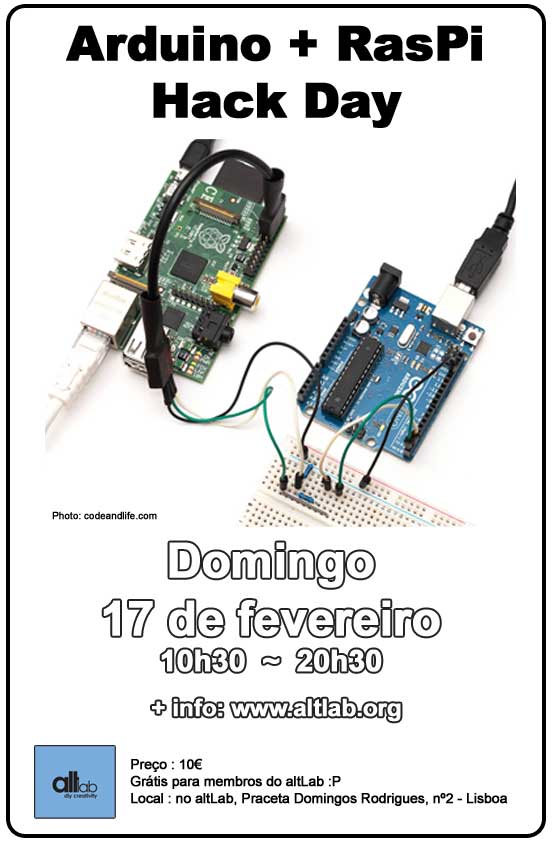
Arduino Sunday!

0


+ info e inscrições aqui

Doming a Soldar!

0


+ info e inscrições aqui

Our Founder @ adafruit #ADA11 Ada Lovelace Day!

0

#ADA11 – Catarina Mota, openMaterials


#ADA11 – Catarina Mota, openMaterials

I’m cofounder of openMaterials (a collective research project dedicated to gathering and sharing data on uses and production methods of materials), of altLab (Lisbon’s hackerspace), of fabriCulture (a project dedicated to promoting open source digital fabrication and maker culture in general), and a member of NYC Resistor.

I’m a phd candidate at FCSH-UNL and a visiting scholar at ITP-NYU. My academic research is funded by a fellowship from the Science and Technology Foundation of Portugal and the UTAustin|Portugal program.

Also helps run the Open Hardware Summit!


About today:

Ada Lovelace Day is an international day of blogging (videologging, podcasting, comic drawing etc.!) to draw attention to the achievements of women in technology and science.

Who is your heroine?

Do you remember which women have influenced you over the years?

Perhaps your maths teacher, one of your university lecturers, or a colleague?
This Ada Lovelace Day on October 7, share your story about a woman — whether an engineer, a scientist, a technologist or mathematician — who has inspired you to become who you are today. Write a blog post, record a podcast, film a video, draw a comic, or pick any other way to talk about the women who have been guiding lights in your life. Give your heroine the credit she deserves!

Who was Ada? Ada Lovelace Augusta Ada King, Countess of Lovelace (10 December 1815 – 27 November 1852) was one of the world’s first computer programmers, and one of the first people to see computers as more than just a machine for doing sums. She wrote programs for Charles Babbage’s Analytical Engine, a general-purpose computing machine, despite the fact that it was never built. She also wrote the very first description of a computer and of software.

If you’re looking to spark the mind of a friend, daughter, sister, cousin, mother, aunt, anyone really — electronics is a wonderful hobby and perhaps a career. We’re doing this sale with the hopes of turning on some minds to science, engineering and curiosity about how things work. We hope you enjoy the sale, the projects and the content we have planned for today.

Today only, if you want to save 10% off on EVERYTHING at Adafruit use the code ADA11 on check out. Code is live for today only, one use per customer. Give a gift of electronics and learning to a special girl in your life.

Filed under: ald — by adafruit, posted October 7, 2011 at 7:30 pm
mm's RSS Feed
Get Adobe Flash playerPlugin by wpburn.com wordpress themes
Go to Top